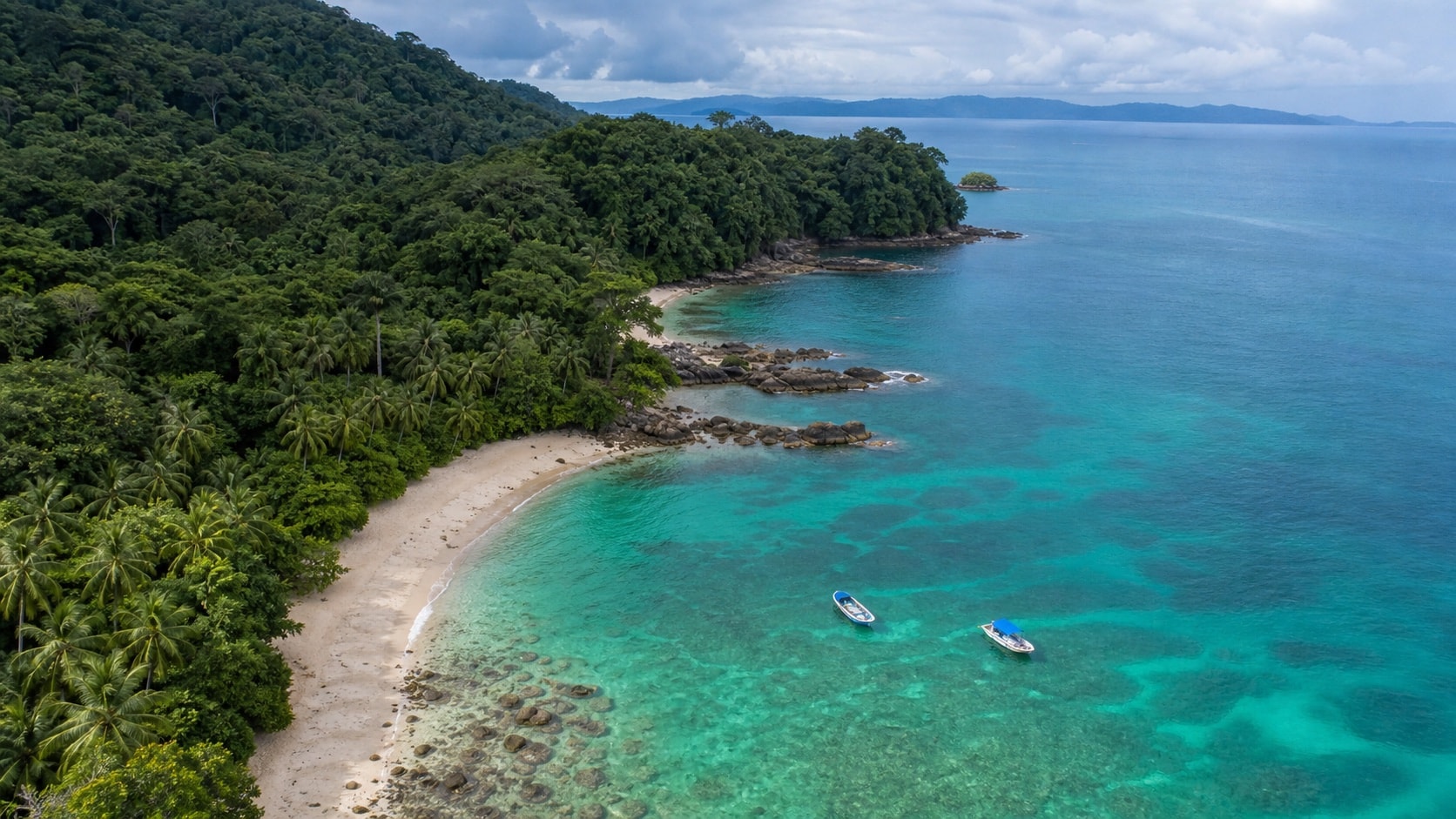
Panama Beach Real Estate: Tons of Reasons to Buy
This page examines a 2009 article about Panama's beaches and coastal property. The article praises tropical scenery, water activities and the appeal of living near the shore. It also illustrates a common weakness of syndicated travel copy: vivid destination language, commercial persuasion, and loosely checked geography can appear in the same passage.
This page is an editorial case study. This is not a property listing and does not recommend a purchase. Instead, it asks how a reader can separate a real sense of place from claims designed to create urgency.
Begin with the map
Panama is an isthmus between the Caribbean Sea and the Pacific Ocean. That position gives the country two distinct coasts, but it does not make every beach interchangeable. Rainfall, currents, access, settlement patterns, and local economies vary from one region to another. A broad phrase such as “Panama beaches” may be convenient for a headline while hiding the differences that matter to residents and visitors.
A reliable first step is to establish geographic facts through a stable reference. The public country guide for Panama provides a concise baseline and curated routes into geographic and historical collections. A baseline is not a full portrait, but it prevents a writer from confusing similarly named destinations or importing details from another country.
That matters here because the 2009 article appears to blend Panama with language associated with Panama City Beach in Florida. The two places share words, not geography. A critical reading should not quietly repeat the mix-up. It should show readers how the error happens and why checking a map is an editorial act, not a decorative extra.
Coasts are lived places, not a feature list
Promotional travel writing often turns a coast into a checklist: pale sand, warm water, boating, fishing, surfing, and an easygoing community. Those details may be present somewhere, yet the list can flatten differences among working waterfronts, protected habitats, small settlements, urban beaches, and resort corridors. It can also erase seasonal weather, infrastructure limits, and the daily work that keeps a destination functioning.
A more responsible article asks which coast, which community, and whose experience is being described. It looks for environmental protections, cultural history, and land use alongside scenery. The international heritage inventory for Panama is one starting point for understanding how natural and cultural significance are documented. It should be read with local history and current official material, not used as a substitute for them.
Recognize the signals of property promotion
Several rhetorical moves recur in destination property articles. Scarcity is implied before it is demonstrated. Other countries or cities are used as price comparisons without matching location, condition, ownership rules, or time period. Population growth is treated as a guarantee of demand. Amenities are listed as though every property has equal access to them. The article then moves from “this place is attractive” to “therefore this purchase is attractive,” even though those are different claims.
Readers can slow that movement by writing the claims in separate lines. Is the statement about the country, a coast, a town, a project, or one transaction? Is it descriptive, comparative, or predictive? What date and source would allow it to be checked? The method in Understanding Sources and Citations is particularly helpful when a page contains precise figures with no visible route back to their origin.
Use travel research to restore dimension
Even when no transaction is involved, the same discipline improves trip planning. Begin with official entry and safety information, then add maps, local institutions, historical collections, environmental sources, and recent reporting. The official international travel planning overview emphasizes checking destination conditions, entry requirements, and local laws before travel. Those practical facts belong beside cultural curiosity, not after it.
Next, compare accounts written for different audiences. A conservation report notices different details from a weekend itinerary. A local history may explain a place name that a promotional brochure treats as a label. A transport map reveals distance and access that a collection of photographs cannot. How to Research a Place Before You Travel turns those sources into a repeatable process.
What the article says
The value of this topic lies in its layers: a recognizable type of early web article and a demonstration of why historical reading requires judgment.
Panama's coasts deserve more than a string of superlatives. Readers deserve a clear distinction between geography, travel description, and property persuasion. That distinction is the lasting reason to revisit the article today.