
Three stories from the motor works
An English roadster, a Japanese prototype and an Italian coupé each tell a different engineering story.
5 min read
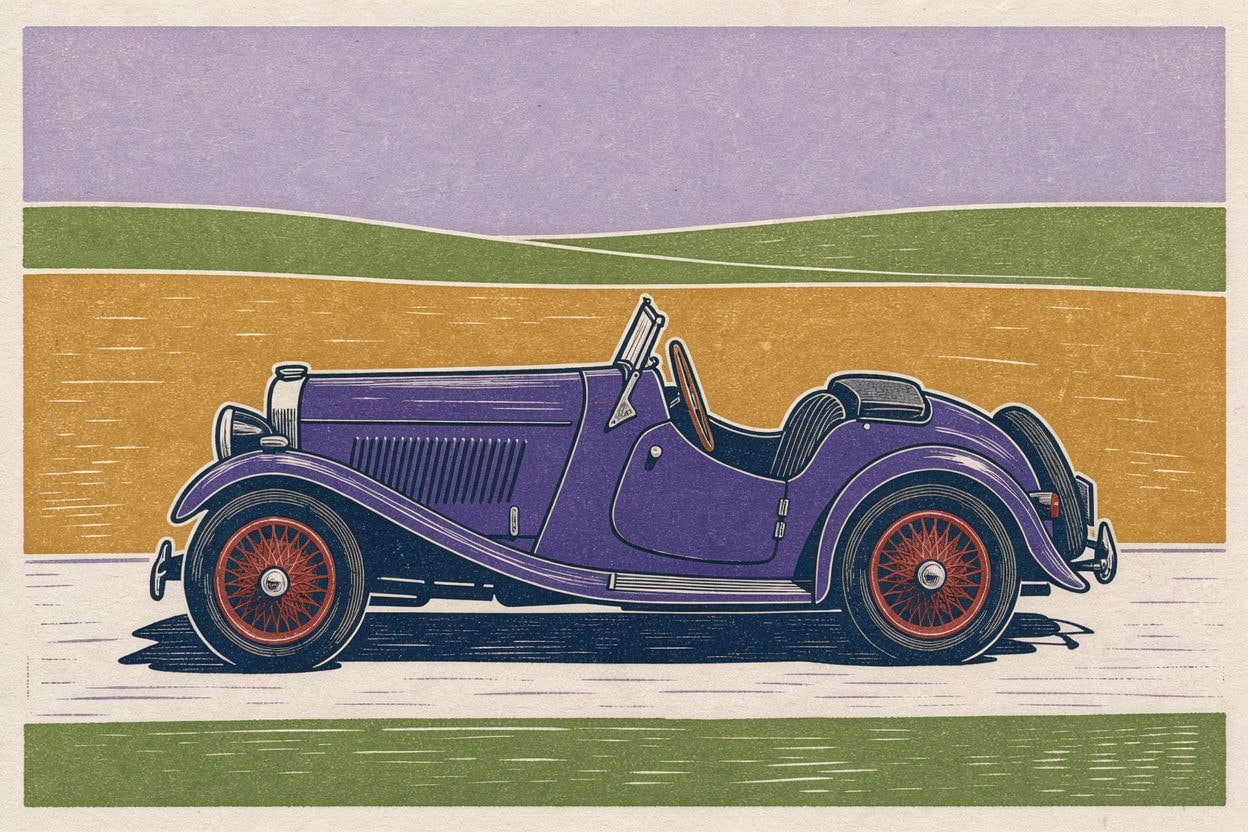
Two MGs parked nose to nose can look much closer in age than they are. Lift a bonnet or look behind a front wheel and the family resemblance starts to give way. On a Toyota prototype the revealing detail is a hand-shaped panel. On a Ferrari it is a part you can hardly see from the pavement.
The MG T series, model by model
MG built its T series across nineteen years and a world war. The early TA could be a roadster with a folding top or a Tickford drophead coupé. A TB in roadster trim looked much like a TA in the same trim. The important change was under the bonnet, where the new XPAG engine gave tuners more scope.
| Model | Year | A detail to look for |
|---|---|---|
| TA | 1936 | A longer, wider two-seater with hydraulic brakes. |
| TB | 1939 | The familiar outline housed the new engine. War cut production short. |
| TC | 1945 | Much of the TB running gear returned. The body gained almost four inches across the seats. |
| TD | 1949 | New body panels and independent front suspension. The Mark II had a more highly tuned engine. |
| TF | 1953 | Restyled bodywork over TD Mark II mechanical parts. |
| TF 1500 | 1954 | A larger engine for the last version before the MGA arrived in 1955. |
The TC traveled particularly well. American buyers could find one in the United States even though the steering wheel was on the right. The TD that followed it changed every body panel, yet the instruments still sat in a traditional-looking dashboard. Sitting in the driver’s seat could give a quite different impression of continuity from looking under the car. MG Car Club’s T-type history
From a loom works to a passenger car
The Toyoda Automatic Loom Works began in 1926. In 1933 a motor-vehicle department took shape under Kiichiro Toyoda, the founder’s son. The team took apart American cars to see how their parts were made. A Chevrolet engine informed the design of its Model A engine. A streamlined DeSoto supplied a model for the body of the A1 passenger car.
Getting cooling water to flow through a cast engine block was one of the first difficulties. The team eventually cast the block, head and pistons in its own workshops. For that first engine it used Chevrolet crankshaft and valve parts. On the body side, the team learned that molds for stamping the panels would take about eighteen months. The answer was to form the prototype panels by hand. The A1 was complete in May 1935. Its curves record the shape the designers wanted even though a different process would be needed to turn them out in quantity. Toyota’s account of the A1 prototype
The factory’s wartime work centered on trucks. The compact SA passenger car reached the prototype stage in January 1947, before the SB truck. The truck nevertheless went into production that April. A public invitation to name it produced “Toyopet,” a name also used for the passenger car. The SA carried its drive shaft inside a single backbone tube and had independent suspension at all four wheels. The truck drew its rear axle and brakes from an earlier car. A shared engine and nickname could cover two quite different chassis. The SA passenger car and SB truck
Five valves and the F355
Ferrari presented the two-seat F355 Berlinetta at Fiorano in May 1994. Its mid-mounted V8 displaced about 3.5 litres. Each of its eight cylinders had five valves, giving the engine forty in all. Read the badge as “3.5” followed by “5” and the number becomes a small piece of the engine specification.
The badge covered three roof designs. The Berlinetta was a fixed-roof coupé. A GTS driver could lift out the roof panel, while the later Spider had a folding top. From above, the roof tells you which F355 you are looking at. Down at road level, all the work that went into managing the air is much harder to see.
For the Berlinetta, Ferrari lists 380 hp, a six-speed manual gearbox and a top speed of 295 km/h. An undertray ran the length of the body to balance the downward force on the front and rear axles. Air passing beneath the car was part of its design just as surely as the familiar intakes in its flanks. The F355 succeeded the 348 and gave way to the 360 in 1999. Ferrari’s Berlinetta specifications
Another number in a car advertisement
An earlier motoring item in the directory asked what a new or used car really costs when it is financed. The figure in large type is often a monthly payment. To understand how that figure was obtained, put the amount borrowed, annual percentage rate, number of payments and total repayable beside it. A lower monthly payment spread over a longer term can leave the borrower paying more interest overall. A comparison involving refinancing also needs to account for any new fees and the remaining term of the first loan. Consumer Financial Protection Bureau on comparing auto loans